

People often ask where our creams came from. The honest answer begins long before Beauty and the Bees, in my grandmother’s kitchen.
Her name was Ada Norman, and she was a wise woman in the old sense of the phrase. She understood herbs. She made things from scratch. And she was quietly renowned for her healing lotions and salves, the sort of homemade preparations that appeared whenever somebody turned up with dry hands, a scrape, or skin that had had quite enough of winter.
One cream in particular has stayed with me all these years. A luxurious face moisturiser, based on a recipe called Galen’s Cold Cream that is nearly two thousand years old and calls for rosewater, beeswax and olive oil. Gran had found it in a library book, promptly torn out the page and taken it home (libraries were a more trusting business back then, or she rather hoped so). She whipped it up by hand in the very same bowl she used for her life-changing sponge cake, with ingredients that were in the cupboard or picked from her herb garden.
Olive oil, mind you, was not something you simply had. In those days, the chemist sold it in tiny bottles for treating earache, and that was about the only place you would find it. So Gran used dripping instead because dripping was what we had. It made a rich and comforting cream, and not one of us thought it is the least bit odd. She saw little sense in buying what she could make better herself.
You have to understand the world she made it in. We were poor. Three adults and a child living in a caravan. My grandfather repaired our shoes over and over again, my grandmother made all of our clothes, and we grew as much of our own food as we possibly could. There was a large vegetable garden, and attached to it her herb garden, where she grew every herb that went into her salves and creams. There was no romantic notion of artisan skincare in the late fifties. It was simply common sense. We made do and mended, as everybody did in those days.

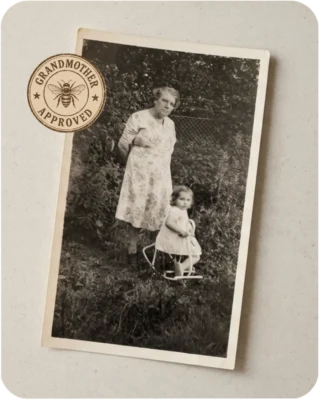
My grandmother, Ada, wearing a dress she made herself. She made all of our clothes, and never once thought it remarkable. Long before handmade became fashionable, it was simply a way of life.
In the spring, I helped her dig the trenches for the seeds. She always let me put in a packet of radishes, having worked out long before anybody used the word that a child needs to see a quick result. I have been a radish lover ever since. And on the first warm days we would sit together on the doorstep podding peas, which were so good it was a wonder any of them ever reached the pot.
She had come to care about skin the hard way. As a young woman, she trained as an auxiliary nurse during the First World War, and it was there she learned how kind calendula could be to sore, burned and damaged skin. That cheerful golden flower, marigold by its common name, made such an impression on her that she grew it in her garden for the rest of her life. There was always calendula, long after the war was over.
Her everyday creams were far humbler than that Galen face cream, and I loved them just as well. Picking the petals was my job. I can still see the colour of them going into the warm fat, and I have never quite forgotten the smell. Nothing was wasted in Gran’s kitchen. That same leftover fat from cooking was carefully clarified, combined with calendula and herbs from the garden, and turned into simple creams for cuts, cracked hands and whatever else family life demanded.
That thrift ran through everything. Once a week, it was my job to grate the hard carbolic soap for the boiler, and as I grew older, I was trusted to feed the washing through the mangle while she turned the handle. That soap got us clean, but it smelled of antiseptic and left our hair in tangles. So she made rose petal vinegar, diluted it, and rinsed our hair with it. The tangles surrendered on the spot, and our hair came out soft and shining.
As a child, I watched all of this the way children watch the people they love, half helping and half in the way, asking endless questions. And without either of us quite realising it, she was teaching me something that would take me decades to properly understand. Good skincare was never about fashionable ingredients or clever claims. It was about knowing what each ingredient actually did, taking the time to make something well, and trusting that nature had usually worked it out long before we came along.
In my late twenties, after damaging my skin with harsh commercial skincare, I developed eczema. I went back to Gran’s old formulas, recreated them and updated them, and in time my own skin settled.
That thread, from Ada’s herb garden to a little market stall in Tasmania, is really where Beauty and the Bees began.

With my grandmother. She taught me that looking after yourself, and the people you love, is one of the simplest and most important things we do.
Years later, when I set about making our own moisture creams, I had no wish to mess with what wasn’t broken. Why mess with the best? So I kept faith with GranGalen’s recipe, that honoured trio of beeswax, oil and rosewater, and simply tweaked it with a few extra skin-loving oils. The creams that came out of it are dense and cushiony, almost whipped, honey-warm to the touch and faintly rosy to the nose. Take up a little on your fingertips, and you can feel it soften and melt the moment it meets the warmth of your skin, sinking in to leave it comforted rather than coated. Calendula is still folded through them, too, which is why some people call them our marigold creams. Our Light, Rich and Ultra Rich Moisture Creams are, at heart, a gentle nod to the little pot Gran whipped up beside her sponge cake.
I think she would be quietly pleased to see where it has all led. And then, in all likelihood, she would tell me not to get carried away.

We like to think this one has her blessing.
If you have ever wondered why a good beeswax cream holds on to moisture so well, we will go into that soon.











What a wonderful story about your Gran; and your faithfulness to her recipes . No wonder your products are like no other!
Thankyou for sharing your story
thank you for sharing your story and with the relationship you had with your grandmother i hope you never change the way things are made with your company i appreciate, respect and wish there were more companies and people like you in this world and yes i am a convert to your products and talk to anyone who wants to listen, i even gave my podiatrist some soap for his beard as he couldnt get the smell of chlorine out of it after taking his daughter to swimming lessons you see you just never know who is looking for something tried and true, natural and works he is very pleased with his results thanks again judy
A lovely story and family history. What a joy to have such a grandmother.