There is an article going around at the moment that we haven’t been able to stop thinking about.
About big corporations vacuuming up small businesses like ours and ruining their products in the name of profit, at all costs.
The Guardian ran it on 10 August, and it opens with a man in the United States called Keyana Sapp, who went shopping for a backpack. The brands he remembered from being a kid, just weren’t the same anymore. When he looked into why, he found they had all ended up owned by the same corporation after a run of acquisitions in the 2000s. So he pulled the same thread through cookware, shoes, tools and clothing, and found the story repeating in industry after industry. Trusted names bought up by conglomerates and private equity, then quietly ridden into the ground until the reputation was the only thing left.
The research in the piece backs him up. Three-quarters of Americans ran into a quality or service problem in 2025, roughly double the rate when that survey started back in 1976.
The line that stayed with us came from Ben Cohen, one of the two Bens behind Ben & Jerry’s ice cream. He described the logic of shaving “a sliver off the loaf of baloney” every year, on the assumption that nobody will notice, until eventually there is no baloney left to shave. He would know. According to the same article, he is currently trying to buy his own ice cream brand back from the corporate group that owns it, and so far he has not managed it.
We read all of that from a small factory in Tasmania, and had a rather complicated feeling about our own history.
The offer that never came
Here’s Jill, our founder, writing to our team this week:
“I used to dream of being given a skip load of dollars for this tiny little brand that I started but it is clear that it’s never going to be anything but that. But, now it’s a source of pride to me that we are small: that allows us the freedom to make the very best quality products that we can, from micro suppliers of rare, clean, unique ingredients in our island paradise. It is what it is, and whilst I’ll never be rich I’m very proud of what we do: unlike big generic corporations with their endless messages of how they value you on the phone (but not enough to connect) we actually answer it immediately. Who knew that trying to reach a human would be so difficult.”
Thirty-three years on, we’re still small, and that isn’t an accident. It’s the sum of a few hundred decisions: to keep buying the expensive honey, to keep cutting and wrapping by hand, to keep making in batches small enough that a human being can actually check them.
Every one of those decisions puts a ceiling on how big we could ever get. Every one of them is also the reason the products are what they are.
The pattern in that article isn’t really a story about greedy people. It’s a story about what happens to a product when the people making the decisions have never met the people making the thing, and have shareholders to answer to every quarter. Somebody notices that a cheaper oil does almost the same job. Somebody notices that if you thin it out with water, you can still call it the same product. Nobody sets out to ruin anything. It’s just that when the pressure only ever runs one direction (profits for shareholders) the sliver that comes off the loaf gets bigger every single year.
Economics as if people mattered
There’s a phrase for all this, and it’s older than we are.
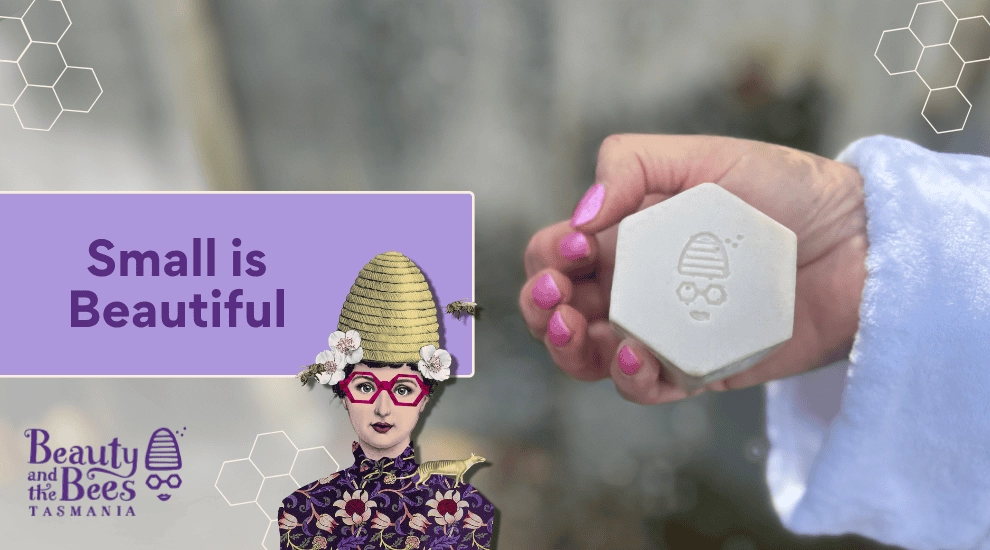
In 1973 an economist called E. F. Schumacher published a book called Small Is Beautiful, subtitled Economics As If People Mattered. He wasn’t writing about shampoo. He was arguing, against the entire mood of the age, that bigger is not automatically better, and that the scale and ownership of a business shape what it makes and how well it makes it. The phrase itself came from his teacher, Leopold Kohr, as a deliberate counter to the prevailing idea that bigger is better. It was never meant as a consolation prize for the small. It was an argument.
Half a century later, an article about backpacks and casserole dishes is making much the same point.
Schumacher’s word for the alternative was “enoughness”: working with human needs and human limits rather than pretending neither exists. Which is, we think, a rather more dignified name for what Jill was describing in that email.
What we’ve never had to do
We have never had to take a phone call from an investor.
That’s the whole thing, really. Beauty & the Bees has never been bought, has never taken outside money, and answers to nobody except the people who use our products. Every decision about what goes into a bar of shampoo has been made by the people who actually make it, standing in the room where it’s made.
It also means we have never had much of a marketing budget, and what we do have is dwarfed by the companies we sit beside on a shelf.
Every dollar we don’t spend on advertising goes into the bar instead. That’s the trade, and we make it again every year: we’d rather put the money into what you wash your hair with than into persuading you to.
Which is why new people still find us the way they have for thirty-three years. One customer mentioning us to a friend.
Not an advertisement. A person.
It means our Leatherwood honey and beeswax still come from the Stephens family, ethical beekeepers who have been working Tasmania’s World Heritage rainforests since around 1920 and who have supplied us since the day we started in 1993. Our olive oil still comes from Ashbolt Farm in the Coal River Valley. Our saffron still comes from Tas-Saff down in the Huon. These are not cheap ingredients, and there have absolutely been years when swapping them for something from a drum would have made the accounts look considerably friendlier.
It also means we’re still making things in small batches, by hand, the slow way, in quantities that would make an efficiency consultant weep. Over 100,000 shampoo bars a year, which sounds like a lot until you realise it’s a rounding error to anyone listed on a stock exchange.
And it means that when we can’t do something properly, we say so rather than dressing it up. Our packaging is about 99% plastic-free, not fully plastic-free, (because non-plastic caps and fastenings for our fully recyclable glass jars have not been invented yet) and we’re not going to pretend otherwise. Our Honey Butter Lip Balm is currently in a glass jar because we haven’t yet found a push-up tube that meets our standards, and we would rather tell you that than sneak the plastic in hope you don’t look. Being small doesn’t make you virtuous. It just removes most of the incentives to fib.
The slow, unglamorous compounding of doing it properly
One of our customers sent us this a while back, and it still makes us smile: “Can’t wait to order again! The problem is your products last sooo long it takes forever to finish them!” ~ Eugenia M.
That’s the business model we pioneered, unfortunately. Our shampoo bars are dense with actual working ingredients rather than padded out with water, so they last about three times longer than a bottle of shampoo, which means you buy from us less often. Buy Better = Buy Less isn’t a marketing line we landed on in a workshop. It’s just an honest description of what happens when nobody is pressuring you to sell more units this quarter than you sold last quarter.
We’ve been saying it for years, and it has honestly never felt more pertinent than it does reading that article. Buying less only works if the thing you buy is actually built to go the distance. When the trusted names are being thinned out a sliver at a time, “fewer, better” stops being a lifestyle choice and starts being a form of self-defence.
Over thirty-three years, that adds up to more than three million plastic bottles kept out of Australian landfill. Last year it also added up to two Gold and two Silver medals at the Clean + Conscious Awards, which was lovely, though the reviews from customers who have been with us since the start of the Salamanca Market days mean rather more.
So, check the label. Then check who owns the label.
The Guardian article ends with the most useful advice we’ve read all year, and it isn’t ours, so we’ll happily pass it on. When you’re shopping, buy from independent businesses where you can. And before you buy, have a quick look at who actually owns the company.
It takes about thirty seconds. Search the brand name and the word “acquired”. You may be surprised how many of the trusted names on your bathroom shelf now belong to three or four enormous parent companies, and how many of them quietly changed their formulations in the year or two after the sale went through.
We’re not asking you to buy from us. We’re asking you to look, at everything you buy, including ours. Read the ingredients list. Notice whether the company will tell you who makes their ingredients and where they come from, or whether the answer is a lot of soft language about nature.
There is one thing we’d ask
We meant that. We’re not asking you to buy anything today.
But if you’ve been with us a while, there is something else, and it costs nothing.
Tell someone.
When one of our bees finds something worth having, she flies home and tells the others. There’s a whole dance involved. It’s called the waggle dance, and thirty-three years on it is still more or less our entire marketing department.
A business that has never taken outside money has no other way of growing. We can’t outspend the big companies, particularly now that Facebook and Google largely control who gets seen and who doesn’t. What we have instead is a few thousand people who’ve used these bars for years and occasionally mention them to a friend who’s been complaining about her hair. That’s how very nearly every customer we’ve ever had found us. Including you.
We know it can feel like a small thing. From where we’re sitting in Tasmania, it isn’t. One person telling one other person is the difference between a small Tasmanian business, and the eight local families it feeds, still being here in ten years and quietly not being.
People have been quietly doing it for us for a very long time:
“Have been using these products for several years… Have recommended to many friends over time.” ~ Heather H.
So thank you. Genuinely. To everyone who has passed us on at a dinner table, in a hairdresser’s chair, in a comment on somebody’s post, or by handing over a bar and saying just try it. You have kept this little business going far more effectively than any advertising ever has.
And if you’d rather not put it in your own words, you’re very welcome to just send them this. It says it better than we manage at a market stall on a busy Saturday.
Small is beautiful, then
Not because being small is virtuous in itself, and we’d be wary of anyone who told you it was. But because when the person deciding what goes into the product that works is the same person who has to look you in the eye at a market stall on a Saturday morning, there is nowhere for a cheaper decision to hide. Thirty-three years ago that person was Jill, arriving at Salamanca on a motorbike loaded with jars of honey and olive oil moisture cream, sharing a stall with Vilma Baker because she couldn’t afford her own.
We’re still at that market. Stall 190. Same island, same honey, same recipes, same nobody to answer to.
Turns out that’s the good ending.
P.S. Talking of small is beautiful, we offer sample sizes of every product we can, packaging allowing. After thirty-three years it’s still hard to avoid plastic entirely at that size, which is the honest reason it isn’t everything. Have a look here.
The Bee Telegraph
Somebody sent you this? Then you’ve already met the only advertising we’ve got.
The Bee Telegraph is where we write about where our ingredients come from, what we’re making, and what we still haven’t worked out. Sent weekly from a small factory in Tasmania.










Leave a Reply