
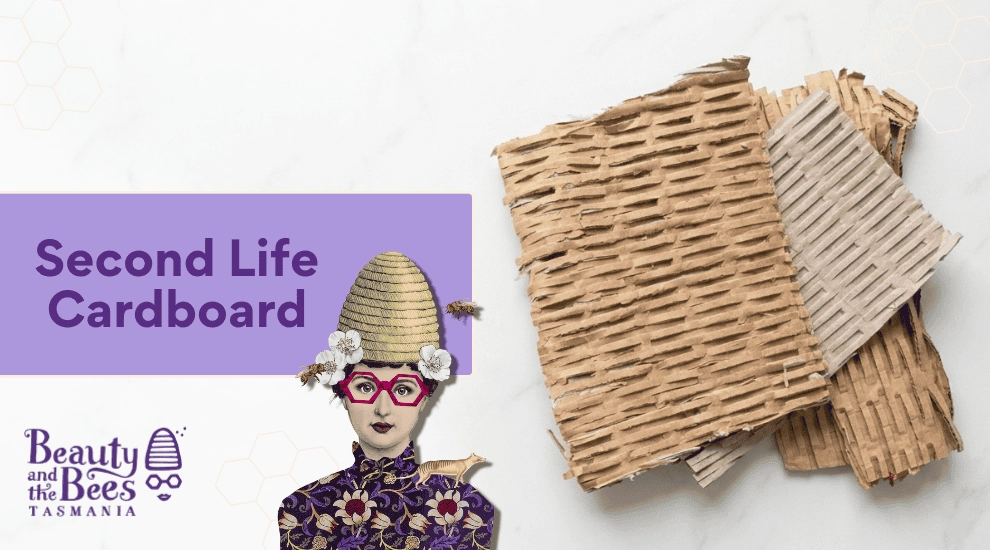
If you’ve opened a ubbleeauty and the Bees parcel recently and found yourself turning over the rather clever-looking cardboard wrapped around your order, you’re not imagining things. It has almost certainly already had a life before this one.
At our Hobart factory we have a machine that does something rather clever with waste cardboard. It takes the boxes that arrive at our door (cartons from suppliers, packaging from deliveries, all the perfectly ordinary cardboard that comes with running a small Tasmanian business) and turns them into a stretchy, honeycomb-like cardboard net.
That net is what wraps and cushions your order before it heads off through the post.
It’s simple. And we rather love it.
Why buy packaging when we already have packaging?
Businesses receive an astonishing amount of cardboard. Truly astonishing.
The conventional answer is to flatten it, send it off into the recycling stream, and then buy brand-new packing material to protect outgoing orders. Which is fine, as far as it goes. But recycling takes energy. And making new packaging takes raw materials, manufacturing, transport and energy of its own.
So wherever we can, we prefer a simpler option. Use what we already have.
It cuts the old cardboard in a particular pattern, letting it expand into a surprisingly soft, flexible protective mesh. Something that arrived as an unwanted box becomes useful packaging all over again.
No plastic air pillows. And no need to buy virgin cardboard packing material to do a job that our waste cardboard does perfectly well.
It’s the same instinct behind giving up bottled shampoo. Once you start noticing how much packaging exists simply because that’s how things have always been done, it becomes quite hard to unsee.
 See How It’s Done
Reuse first, recycle afterwards
Recycling is a good thing. We’re just not convinced it should always be the first thing.
If a material can be used again before it enters the recycling system, we think it should be. So the cardboard that protected somebody else’s goods on their journey to us gets a second trip, this time protecting your Beauty and the Bees order on its journey to you.
Then, once you’ve unpacked everything, it can go into your cardboard recycling. Or, if you can find another use for it around the house, in the garden, under the pot plants, padding out your own parcels, you might squeeze a little more life out of it before it heads off to be recycled.
One piece of cardboard. Multiple useful lives. Then recycling.
It may not always look immaculate, and that’s rather the point
Because we’re reusing cardboard, your packing material won’t be pristine or perfectly uniform. It won’t look as though it has just come off a roll from a packaging supplier, because it hasn’t.
We’re quite comfortable with that.
We would far rather send you something protected by cleverly reused cardboard than buy something brand new simply because it looks prettier the moment you open the box.
For us, sustainability has never been about grand claims. It’s the same thinking that has shaped everything here since 1993: buy better, buy less, and pay attention to the small decisions. What we make. What we buy. What we reuse. What we recycle. And, most of all, what we can avoid throwing away in the first place.
Sometimes the most sustainable packaging is the packaging nobody had to manufacture at all.
It’s already sitting in the cardboard pile.
Next time you order, have a look at what your parcel arrives in. And if you’ve found a clever second use for yours, we’d love to hear about it.










Leave a Reply